Written by:
Alice Wood
Marketing & Comms Coordinator
I was lucky enough to sit down with author Polly Ho-Yen who has written ten children’s books, and more recently, a novel for adults. You can watch the full interview here. Her writing sits beautifully between the familiar and the fantastical: worlds grounded in reality, yet infused with wonder, science fiction, and touches of magical realism.
Before becoming a published author, Polly worked as a primary school teacher in London, writing in the early mornings before the school day began. She continues to visit schools regularly, meeting the young readers enjoying her stories.
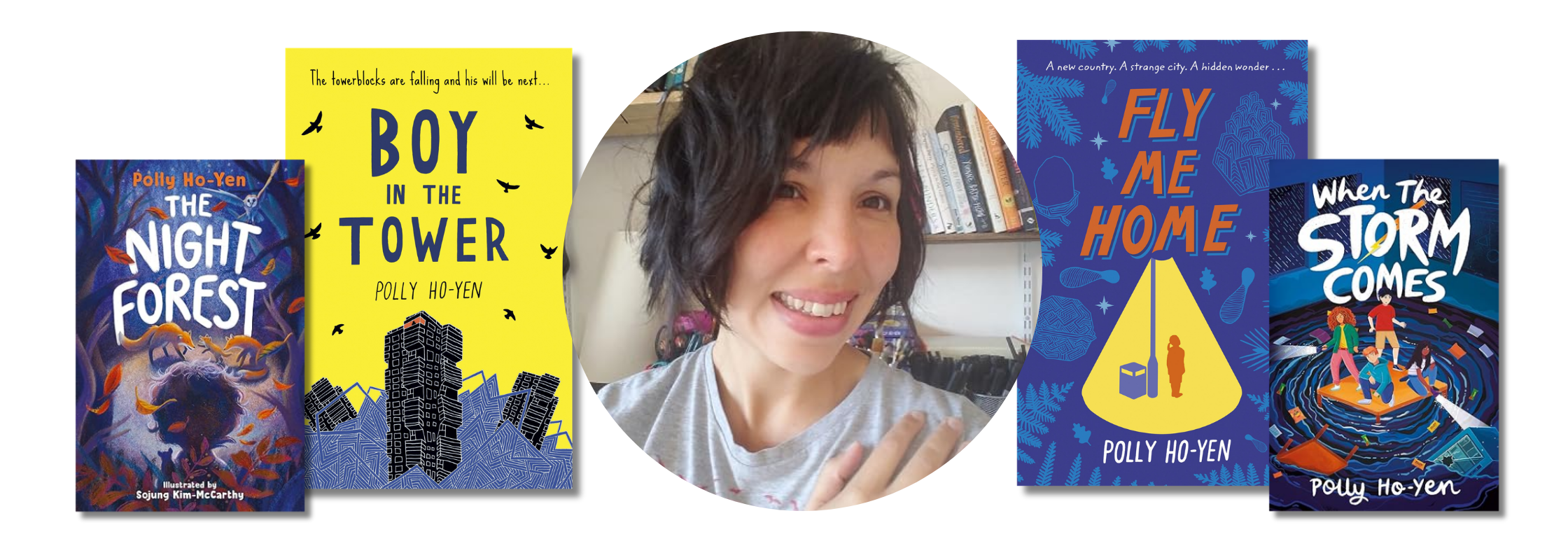
We have two of Polly’s books on the Literacy Tree shelves: Boy in the Tower, her Carnegie-shortlisted debut, and Fly Me Home. In this conversation, we focus on Boy in the Tower, for which we have a Year 6 Writing Root, as well as Polly’s creative influences more broadly.
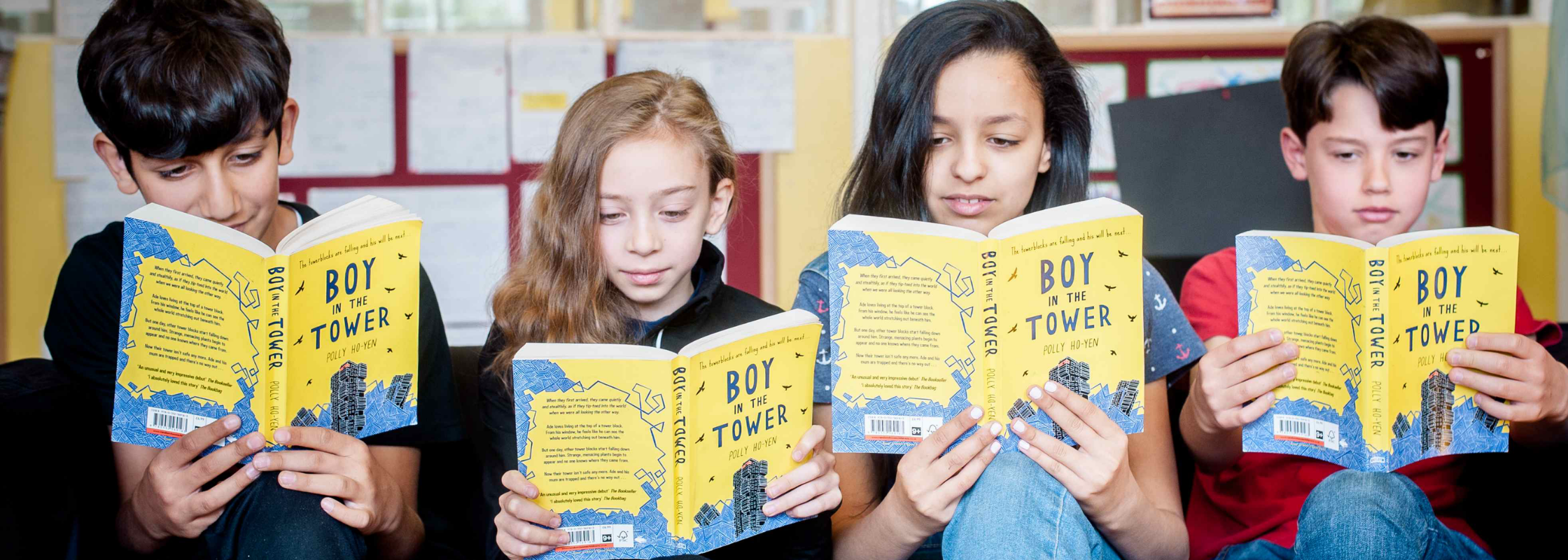
Boy in the Tower was one of the first books I picked up after starting at Literacy Tree – and one of the stories that has stayed with me ever since. For readers new to the story, the novel follows Ade, a young boy living with his mum in a tower block. As mysterious plants take over the city, nearby buildings begin to crumble, but Ade’s mum grows increasingly withdrawn, spending days in bed. Their chance at escape slips away, and so trapped inside the tower, Ade forms close bonds with the few neighbours who remain. We follow this unlikely group of strangers – a true found family – as they work together to survive the triffid-like jungle taking over their city.
Alice, Literacy Tree:
A lot of the themes explored in the book are quite challenging: grief, responsibility, resilience. I wondered whether your experience as a teacher, working so closely with children, has increased the level of trust you place in young readers to approach difficult themes?
Polly:
When I was writing Boy in the Tower, I was actually teaching much younger children. The kind of the readers I was hoping for were Year 5 or 6 children, and they felt so grown up and huge because I was with such young kids. They have completely different ways of being. So in my little closeted Key Stage One place, I was looking up at the Year 5s and 6s and thinking: ‘wow, they are so worldly wise, they can handle anything.’
And also I think at the time that I was writing, I felt very much connected to myself as a child reader. Sometimes people ask me, how do you - or why do you - write for children? The honest answer is I don't really know, but I do still feel a very strong line between myself as I am now and that young reader. I'm childlike, I suppose, but I'm proud of it because it's helped me in so many ways to keep creating. When you write, you're constantly diving into the shoes of yourself as a reader. You put that hat on and ask: “Do I feel immersed here? Do I feel like I am taken away?” The part of me which is writing for myself as a child reader felt that I could have handled this story.
As I've gotten older, I have another lens, especially now I am a mum. Quite a lot of mums, who were also teachers, said to me after they'd read Boy in the Tower: “I found it really hard. I found it really challenging to read about the relationship between Ade and his mum - seeing him being so capable and having to bear that responsibility.” It is a lot and I feel that more now.
I trusted in him and I trusted in the reader to feel secure and safe, that his story will bear out. But I think now, as a parent, I do feel things in a different way – I feel the vulnerability.
Alice, Literacy Tree:
As readers, we inhabit Ade’s perspective. We experience everything he does, yet there is also a sense of distance - a feeling of not fully understanding what is happening, both to his mum and to the city around him. We feel deeply for both Ade and his mum, navigating nuanced emotions: frustration that she cannot care for him as she should, alongside profound compassion for what she is enduring as her mental health deteriorates.
Polly:
It's always incredible when you do see a child navigating really, really difficult circumstances. And I think as an adult, we've come with our adult head, our adult jumping forward, and our adult wondering about what to fix and how to help. And actually a child will always experience it moment by moment. It's awful that Ade is experiencing this harshness in his life, but he is able to manage it, and even thrive in it moment by moment.
And that was a real gift as a writer – it helped me to keep coming back to experience: let's really root this in where this character is in this moment. That helps me in so many ways, to be able to finish a book, to feel connected to a character. It works on so many levels to just come back to: “What is the experience? How is it manifesting? How is that feeling? How can I convey that in the words?”
Alice, Literacy Tree:
Boy in the Tower was published in 2014, six years before Covid, and I was thinking about how many children's experiences during that time would have closely mirrored what Ade was going through - in terms of isolation and claustrophobia, especially in spaces without access to the outside. So I’m intrigued to know whether you noticed readers resonating on a more personal level with the book during and after the pandemic?
Polly:
Absolutely! In fact, I think people were quite shocked when they realised when it was written, because they really thought: “of course Covid has inspired this.” Ade's going through this completely unique experience, and what we experienced with the lockdowns was also completely unique and world changing. There were so many parallels. It was a little bit scary for me in a way, because I thought maybe I should be writing about something a little lighter and happier for us. But I did enjoy writing the build up to the plants taking over. As the writer, you know what’s around the corner, but the characters don’t know what’s coming. There's a sort of awful playing God in your own story that feels kind of exciting.
When I was looking back at the timeline before the lockdown, it was sort of bubbling... We knew something was wrong and it felt sort of slow and then very, very fast. In the book I was aiming of that experience of knowing there’s something in the air, but then it lands and everything is changed.
Alice, Literacy Tree:
I completely resonate with what you were saying about Covid coming on so quickly and that mirroring Ade's experience. But what I love is that you get lightheartedness alongside all this heaviness. You get these beautiful moments where people are banding together, in the middle of a really traumatic shared experience.
The tower block holds lots of hope alongside fear, and I wanted to ask you about what drew you to it as a setting? What did you hope children who might never have stepped foot in one might take away about these spaces?

Polly:
The school I was teaching in was kind of under the shadow of a tower block. And part of the job was to go and visit children’s homes and families before they joined the class. So I went to meet quite a few families in those tower blocks and one visit in particular really stays in my head. We were very late - the lift was broken and we were running up the stairs. We finally got there and the family were the warmest people. They had the loveliest home. As soon as we walked through from the stairs, which felt impersonal and hard, I felt that real sense of what a special home it was. And that really came from the warmth of the mum and the love between her and her two boys. I can go to that memory so quickly in my mind: that feeling of being welcomed into their home, and then seeing the view from their window which was just what they saw every day. They were just scrambling around in front of this huge window with staggeringly amazing views across London. I really think that experience made me land on the tower block.
I don’t live in a tower block, but I do live in a community of terraced houses, all very close to each other. I can't really imagine not living where we are living now. I love the fact that if I just go out my front door, I will see so many of my neighbours because we are just physically so much closer. The community here is very special, and it's taken me a long time to understand what community is, what it means and what it feels like. But I think going into that tower block in London, meeting that family and being at that school, lay the groundwork for what community feels like.
Alice, Literacy Tree:
I think a key takeaway of the story is that the people make the place. The tower block can, from the outside and within the corridors, feel quite austere, but when you're in Dory's [one of Ade’s neighbours] flat and she's cooking food and cracking jokes, you get this sense of warmth, safety and retreat that Ade is not getting in his own flat. This pocket of safety that's created amidst the terrifying world outside the window, and in his personal life, felt really special.
Polly:
I think it's nice that you mentioned the cooking and the food, because I think that was a part that felt very important. It was fun for me to imagine how they could share food and how that tied into the connections being made and feelings of safety. I love that about sharing a meal together.
I was thinking about all of the great writing tasks that you have associated with the book. And there’s one more I think could be fun to do: creating a meal planner from food scavenged in the tower block. What are you eating? Whose flat is it from? What were they like? What would be perishable, and what could be eaten?
Alice, Literacy Tree:
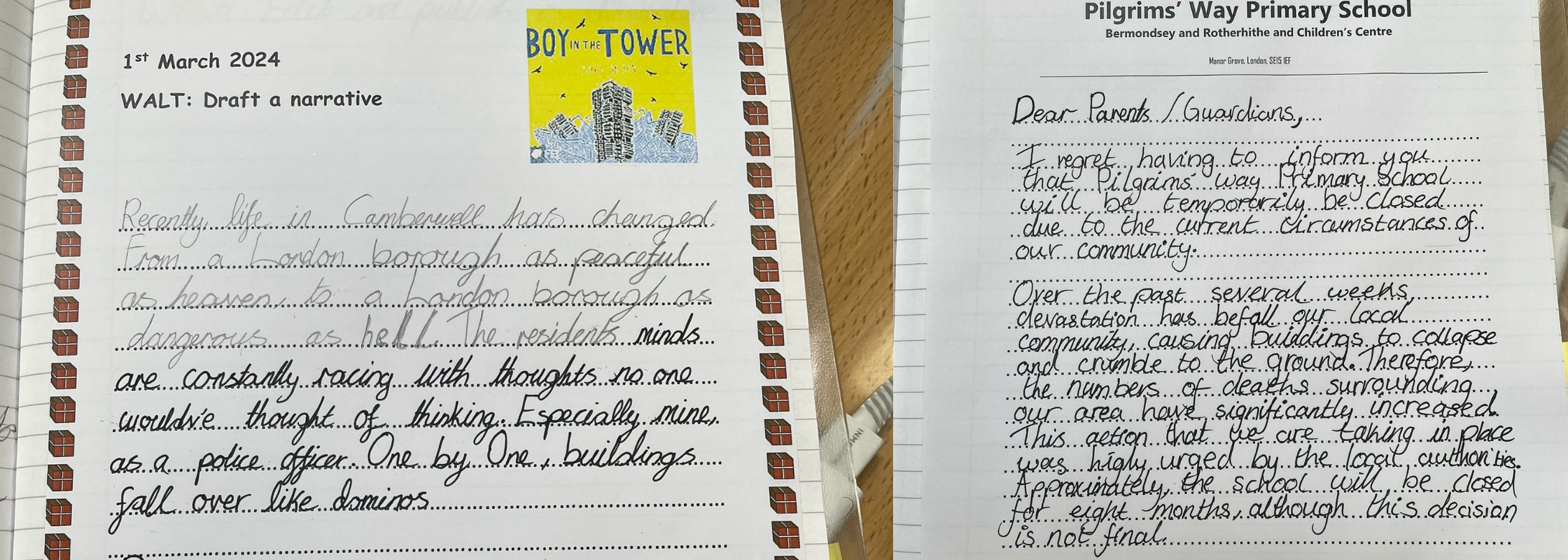
Absolutely - I'm going to feed that idea back to the Resource team! We love short tasks like these, because they give children an immediate context and purpose for writing. For Boy in the Tower, we already ask children to write school closure letters and packing lists, so a meal planner would fit right in.
I want to move on to asking you a few more questions about Literacy Tree's writing planning based on the book.
In our Discovery Point (hook) lesson, we focus more on immersing children than getting them writing. For Boy in the Tower, we transform the classroom with vines and plants growing up the walls, and teachers play the iconic 1960s Day of the Triffids trailer.
Have you always been a bit of a sci-fi fan, or did it just happen to be a powerful vessel for telling this story?
Polly:
I really enjoy sci-fi, but I wouldn't say I'm an expert at all. I was taking pieces from a few core texts, and a lot from film too, I suppose. I grew up watching slightly over-the-top, end-of-the-world narratives like Independence Day, which had a really big impact on me. Boy in the Tower has got this sci-fi element, but it also has that really human element. That’s the driver of the story.
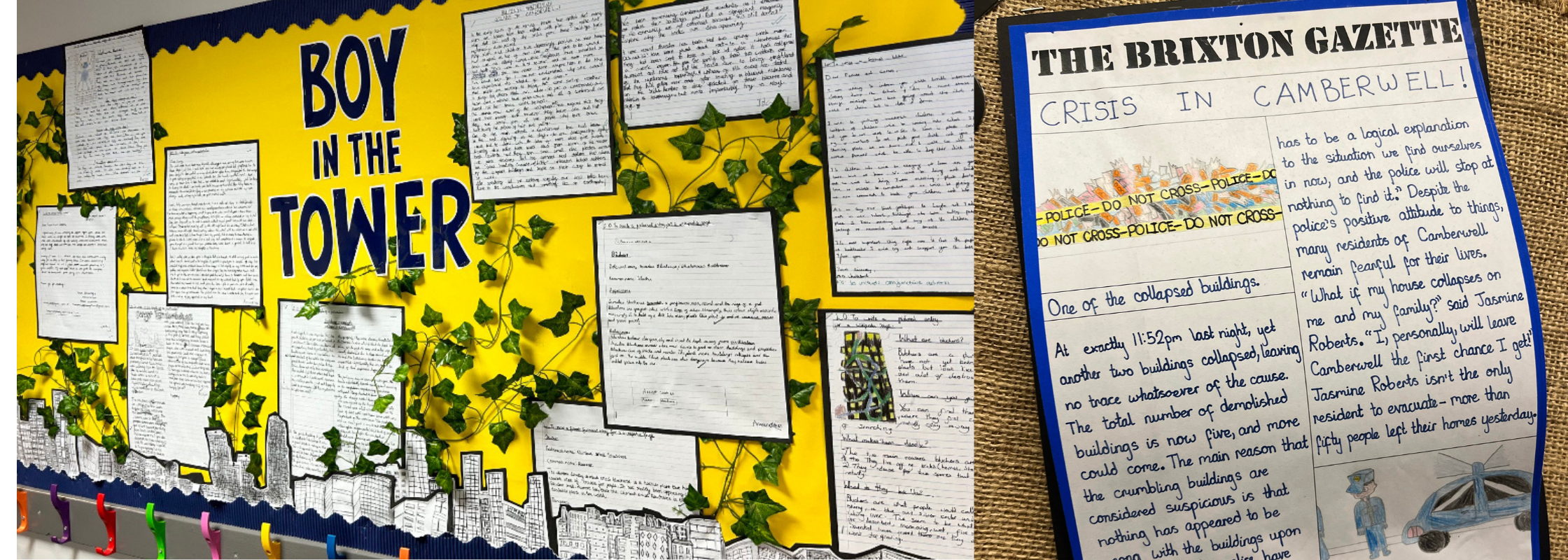
Alice, Literacy Tree:
I wanted to ask you, again as a former teacher, what do you think is important about immersing children in the book and an experience?
Polly:
I think it's vital and I think there are so many ways in. The classroom takeover you’ve described is so wonderful.
I didn't have an experience as a student of someone creating this incredible experience. I have so many memories of thinking: “What are we reading today? I don't think this is going to be my cup of tea.” So I think it's wonderful to actually remove that feeling and go straight in. It feels fun. It feels like this is taking us to another place, and it's great to really live that with the students. I did that a lot in Key Stage 1 through things like a huge letter appearing in our classroom from the giant, or Goldilocks destroying everything.
Curiosity and excitement being the starting point going into a text is very powerful. I have a daughter who's in Year 1 now and if she's missing a day from school, she’ll say: “Oh, but there might be something really great happening today.” School is a place of possibilities, and I'm so glad that she's got that.
Alice, Literacy Tree:
Absolutely. I remember it's sometimes the experiences that feel out of the ordinary or even a little bit naughty that stick with you. When I was at school, we took the models of Stuart London we'd been building for weeks outside, and set them on fire in the playground. Nothing like some fire and pyrotechnics!
I now have a bit of a nosy segment, where I want to hear about your reading experiences. Is there a moment from school - a book, a teacher, an experience - that helped you to fall in love with storytelling?
Polly:
Yes, there is. I think I was about eight and at my school the headmistress would come and read to us every week for an afternoon. She was a very lovely woman, but she had gravity and felt a bit magical in some ways. Now I know she was just a woman, but she was all those things for me at that age when she said she was going to come and read a chapter every week. She read The Diddakoi by Rumer Godden, and it was amazing. I felt transported and just wanted to know what would happen for Kizzy, the main character. It was an experience of a life I didn't know anything about, and I was captivated. It was a golden time – that classroom, feeling the warmth of that story and the sounds of her voice. Being surrounded by the hubbub outside the classroom, but all the focus was just on listening to this story unfolding.
I asked my parents to buy me a copy for Christmas so I could have that story. I just couldn't let it go and reread it and reread it and reread. It was a really special experience to have that delivery, just listening to this teacher week by week.
Alice, Literacy Tree:
I had a similar experience. Like you say, at that age, you see adults as slightly mythical, especially if they're not your class teacher. My headteacher personally recommended me a book and lent me their copy – it felt so magical. They knew who I was and had carved out time from their busy schedule to share a story with me.
Polly:
Exactly - she's an important person, that’s saying: “this is an important way to spend time.”
Alice, Literacy Tree:
Polly, it's been such a pleasure to talk to you today. I've really enjoyed our conversation. I know you’ve had two books out in 2025, but before I let you go, I wanted to ask whether there’s anything in the pipeline?
Polly:
The two books out in 2025 are The Night Forest, for an older, middle-grade reader, and When the Storm Comes which is for a younger reader. They are very special to me because these are going to be the last books that I publish with Knights Of. I’m really sad they have closed.
And lots has happened for me personally recently, which has made writing kind of challenging - impossible in some ways. I've got lots of projects that I'm working on though, so I'll just say, watch this space. Wish me luck and happy reading!