Written by:
Pippa McGeoch
Senior Consultant
Finding, searching, seeking, exploring… however we put the act of looking, it is something that we do continuously when we consider our sense of self and place in the world. We search for clues; we seek answers, we explore themes and concepts. And the need to do so is innate.
This month, all of our choices have an element of this ‘act of looking’, be that a search for the moon that signals the start of a celebration or an exploration of how to communicate effectively so that we are heard. All incredibly different titles, some by seasoned authors and illustrators and some by newer ones, but all highly worth introducing to the children and young people in your lives.
 |
Picture book for children in Early Years
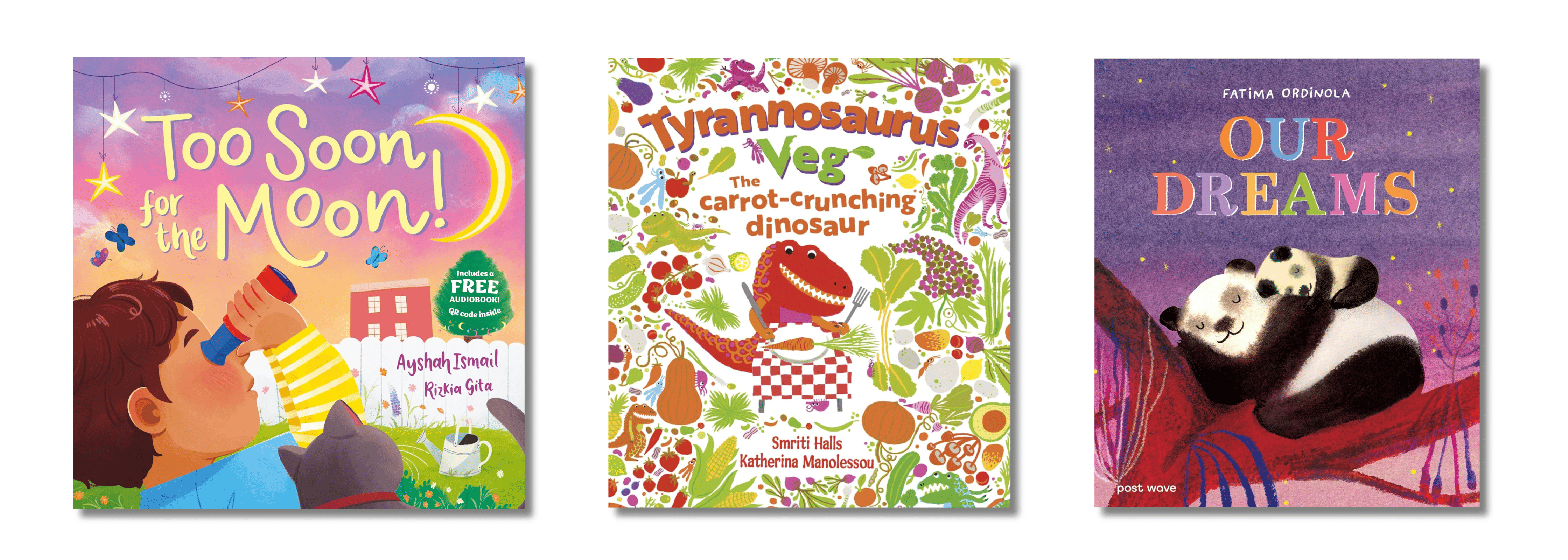
Too Soon for the Moon by Ayshah Ismail, illustrated by Rizkia Gita
(Salaam Cherry, 29th January 2026)
Ramadan is due to begin around the 17th February this year and will likely end around the 18th March. The timings of Ramadan are lunar cycle dependent and the importance of the moon’s first appearance in its ‘new’ phase is explained in this delightful book.
In this debut release for Salaam Cherry publications, we meet Khalid and his family observing Ramadan and preparing for Eid. Khalid is desperate to find out when Eid will be… there’s the excitement of the build-up, the delicious foods when fast is broken and the sweet treats being baked for Eid itself, including baklava – a favourite of Khalid’s.
Mama explains what a crescent moon is and Khalid sets about finding it. But it’s too soon for the moon! He asks Baba where the moon is, gazing up at the dusky sky through his binoculars and thinks he has finally spotted it …but it’s just the moon-shaped fairy lights that have been used to decorate the garden. It’s still too soon for the moon…but what is that glowing arc peeping through the night sky one evening. Could it be the moon? Eid Mubarak, everyone!
Such a joyful festival story, told through the eyes of a small child who can’t wait for the celebration to begin. Beautifully illustrated by Rizkia Gita with vibrant depictions of a loving family. Perfect for a celebrations/ religious festivals topic in Reception.
Picture book for children in KS1
Tyrannosaurus Veg by Smriti Halls, illustrated by Katherina Manolessou
(Faber & Faber, 15th January 2026)
Reginald is a T-Rex. He stomps and roars and does all the other T-Rexy things one would expect. But unlike the others (who happily eat steak, being as they are carnivores) he munches on crunchy carrot cake. This worries Reginald. It makes him feel different and the others have noticed, too. His parents worry that he’s not eating what they feel he should be eating; the children at school tease him and even his best friend passes comment. So Reginald decides to leave, seeking better friends who’ll understand me more. The truth might be that actually I’m a herbivore. But living his truth proves to be a lonely business. He’s cold and wet and no good at foraging.
The ‘herbies’ he approaches run away, fearing that they might be about to become Rex’s lunch. Meanwhile, his friends and family back home are missing ‘T-Veg’: they reason that it really doesn't matter that he’s different. He might eat fruit and veg but that doesn't make him a lesser dino… a lovely way to broach so many different types of discussions with younger children: about diet – both in terms of preference and need, vegetarianism/veganism, acceptance, all in Smriti Hall’s clever rhyming pattern with Katherina Manolessou’s delicious veggie-themed colour-pallete in greens and oranges. A fabulous book for children in KS1.
Picture book for children in KS1
Our Dreams by Fatima Ordinola
(Post Wave Children’s Books, 29th January 2026)
In this companion text to ‘Our Love’ (Fatima Ordinola, January 2025), stylish watercolour illustrations of adult creatures and their young provide a soothing accompaniment to the lullaby of words. No matter how we sleep – or where – our dreams will be able to find us. Whether we are squirrels curled up together or bats hanging upside down, the young safely tucked under a parent’s wings, we can still rest and drift off to sleep. There’s a nod to sheep-counting (which would be a lovely discussion point in class) illustrated with the sweetest sheep, pillowy puffy clouds of woolly coats huddled together peacefully. This is such a perfect book for a bedtime story or even for a moment of pause in a busy school day and would be useful for little children who might struggle to fall asleep at night.
 |
Novel for children in KS2
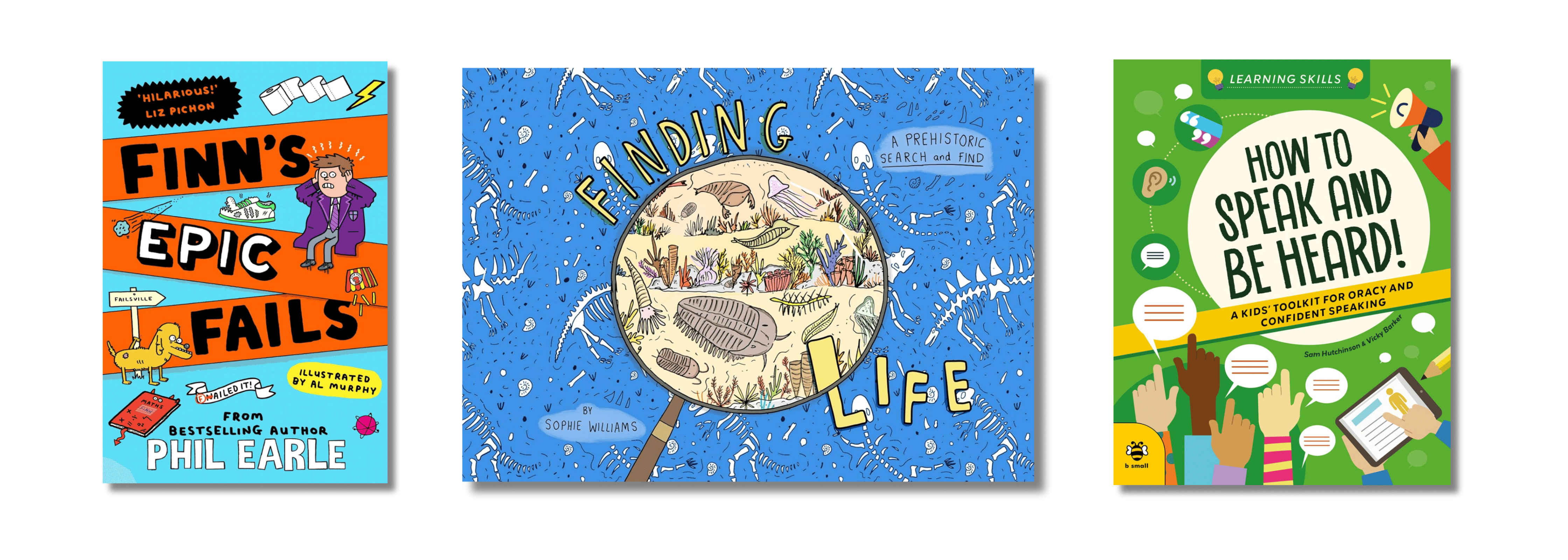
Finn’s Epic Fails by Phil Earle
(Simon & Schuster Children’s UK, 29th January 2026)
Finnley N.O. Hope bursts into being in the kid-lit world this month and is the first instalment of a brand-new series. We’ve been lucky to have been sent a proof copy, and I must say that it’s had me guffawing from the start.
The characters are likeable but there’s a real sense of ‘soul-searching’ and trying to find out who you are and how to be (and Finn’s little sister who is five is SO reminiscent of my own daughter when she was the same age in all her eccentricity!) Finn is a tweenager, age 11 and in Year 7. He has two brilliant friends: Laszlo, a true romantic and obsessed with meeting ‘the one’ and Google (a nickname – obviously) who is as sharp as a tack and has earned her moniker due to her encyclopaedic knowledge of – basically – everything. But she’s kind with it, too and fiercely protective of Finley.
Very different in setting, plot and characterisation to Phil Earle’s more recent books but it only shows his versatility as an author and the situations in which Finn finds himself are acutely observed. Brilliantly written with real heart, we think that this will be a popular read for children in UKS2 and Year 7 and ideal to buy a few copies of to pop in a Year 6 class library so children who would like to read alongside a group of peers can do so.
Non-fiction for children in Years 1/2-4
Finding Life by Sophie Williams
(Cicada, 11th December 2025)
Sophie Williams – illustrator of ‘Earth Shattering Events’ by Robin Jacobs (Cicada, 2019) – has created something rather magical in this new non-fiction book. This is a prehistoric ‘search and find book’ with a plethora of creatures, ranging from Anomalocaris to Zygomaturus, for young readers to spot on every double-page spread.
The book starts with a handy time-line which plots not just the periods in the history of life on earth but also the eras and – I must confess – ‘eras’ and the ‘holocene’ period I may be familiar with in musical spheres but not in terms of evolutionary ones! As well as the distinctive illustrations, cartoony and characteristic of Sophie Williams’ style, what really strikes me is the fact that life in all its forms has faced, been defeated by and then re-emerged over and over since the start of time. And I can’t help think that this serves very well as a ‘get knocked down then back up again’ message. (Yes – another musical reference there!)
So much to learn and children will find this utterly fascinating as it is truly a deep-dive into not just dinosaurs but all that went before and what came after, too. A great addition to a school’s non-fiction library.
Non-fiction for children in Years 4-6
How to Speak and be Heard by Sam Hutchinson and Vicky Barker
(b small, 5th February 2026)
Part of the Learning Skills series, this is a toolkit for children to develop oracy and confidence in speaking OR communicating in a preferred way (such an inclusive lean toward people who use communication devices, sign or other forms of non -verbal communication to speak and we’re very glad to see this!) In one of the earlier sections of the book – ‘More Than Just Words’ – it reads: Speaking is about expressing your thoughts and feelings. There are lots of different ways to speak and they are all very personal.
There is also a clear breakdown of oracy skills including the need for team-work, critical thinking and believing in yourself. Subsequent sections explore the type of vocabulary that pertains to specific situations and even includes a section on making jokes – how and when. On a personal note – I dearly wish I had had access to something like this when I was a child and so too do I wish my teachers had been more aware of the skills involved and how to nurture these skills for those who may struggle. Because, this is a book that acknowledges that communication can be hard and that public speaking, group exercises and even one to one interactions can be difficult. This couldn't be more perfect a non-fiction offer in terms of how much this kind of thing is needed in schools, especially with the new Writing Framework and upcoming new curriculum.