Written by:
Hannah Baker
Senior Consultant
What is the purpose of a Vocabulary Vine?
You may have noticed more examples of our newest resource, the Vocabulary Vines, landing on our platform this half term. These resources will continue to be created and added throughout this academic year, but what are they and how can they be used for impact?
A Vocabulary Vine is designed to be a sister resource to a Writing Root and a Spelling Seed. It sits within our wider Teacher Through a Text approach by explicitly identifying vocabulary from each book and providing opportunities for paired, small group and whole class experimentation with this vocabulary in context. Each Vocabulary Vine also provides oracy opportunities through a focus on talk tasks and on oral sentence construction.
Vocabulary Vines are intended purely as oral resources, designed for short burst discussions and vocabulary development.
How do the Vocabulary Vines work?
Each Vocabulary Vine in broken down on the page into small chunks, or short bursts, numbered typically from 1-5. The idea is that teachers will be able to use these small chunks as discussion opportunities peppered throughout a week or half term alongside exploring the same book during Literacy sessions.
|
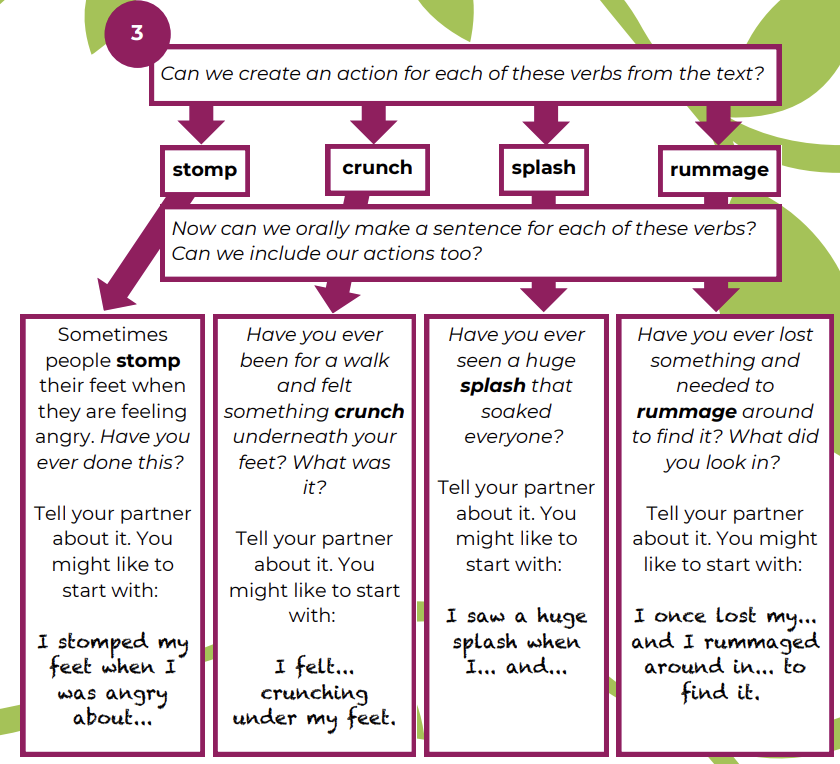
Each short burst pulls an interesting word or phrase from the text and enables exploration of its meaning with depth in context. Short bursts also give children opportunities to speak together with a partner or in a small group, formulating their thinking and sharing it with others. Optional sentence prompts and models provide support and children are often encouraged to consider the role of their body language and vocal choices with their audience in mind too. This short burst example from Billy and the Beast shows how Year 1s might be encouraged to internalise the meaning of verbs from the text through actions and then put their own experiences into clear oral sentences. |
 |
What will I find in each Vocabulary Vine?
Vocabulary Vines also complement Spelling Seeds through their exploration of the morphology (word structure) and etymology (origins) of words.
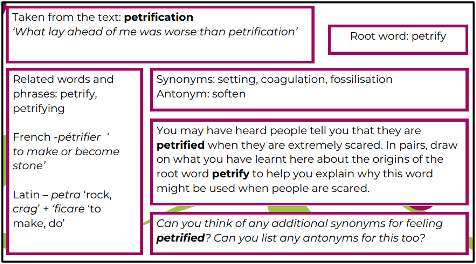 |
In each Vocabulary Vine, one short burst is dedicated to a word’s etymology and it is broken down for exploration. This short burst for Year 5s exploring Percy Jackson and the Lightning Thief exemplifies one such short burst. There are regular opportunities for children to play with prefixes and suffixes too to understand word structure more deeply. |
|
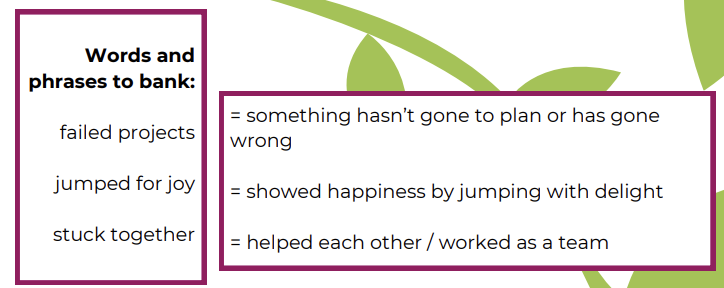
Each Vocabulary Vine highlights some stunning language choices made by the author as potential Words and Phrases to bank (as seen here in this short burst example for Y4s exploring The Barnabus Project). These could be added to the class Working Wall and returned to. |
 |
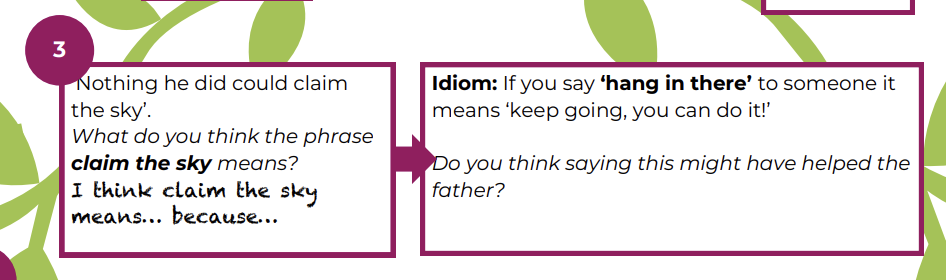 |
Each Vocabulary Vine identifies an idiom that the children might not have come across before to help them build their knowledge of the complexities of literary language and the English language more generally, as exemplified here in a short burst example for Year 4s exploring the book FArTHER: |
Idioms and Words and phrases to bank are generally found as the final short bursts within these resources.
How long does a Vocabulary Vines ‘short burst’ need to last?
A short burst session could range in length from anything between 10 and 30 minutes, depending on the time available in your timetable. It is a purely oral session – ensuring we provide planned opportunities to get children talking, listening and sharing together and trying out language in context – in a safe, playful environment. Ultimately we want to help foster the skills and confidence within our children to communicate their thinking clearly and authentically with others for effect and impact as they move through school and life beyond.
Where can I look to learn more about oracy?
If you wish to explore oracy further, you might like to visit the following blog posts in our oracy series:
1) We Need to Talk: What does the Oracy Education Commission’s report mean for Literacy Tree schools?
2) What do we mean (and not mean) when we talk about oracy?