Written by:

Chloe Burridge
Head of Curriculum Content
Assessment cycles can often feel overwhelming, and it sometimes feels hard to know what ‘on track’ writing looks like. Often it can feel as though end-of-year judgements and reporting all arrive at once, leaving teachers asking the question: What does writing at age-related expectation really look like?
Moderation meetings and writing scrutiny can be useful tools in building teacher confidence as well as supporting with alignment and standardisation. At Literacy Tree we recognise the cyclical nature of assessment; celebrating embedded skills, identifying knowledge and skills gaps, implementing changes to support all children in making swift progress. We’ve been working hard to build a tool that supports schools and gives them confidence in making informed judgements that ensure consistency in writing outcomes, as well as acting as a springboard for developing writers with their next steps. Introducing our new exemplification materials, now available for Years 1, 3, 4 and 5.
Built in collaboration with Literacy Tree schools and developed through careful team moderation and review, these resources are designed to support professional dialogue around writing assessment across your school. Most importantly, they are designed to build teacher expertise in assessment.
Why we created them
Schools have been asking for high-quality exemplification materials for years. We wanted to create something that goes beyond simple “tick-box” assessment and instead supports teachers to develop stronger subject knowledge, understand progression over time, make confident assessment judgements, identify next teaching steps, and helps to close the assessment-to-planning loop. We also wanted to provide examples of writing from our Literacy Tree schools, supporting teachers in applying their expertise in assessment to Literacy Tree ‘Teach-Through-A-Text’ outcomes.
As a curriculum content team, every resource decision comes back to the question: How can we help teachers feel more confident in understanding children’s literacy development?
What makes our exemplification materials different?
1. They show a collection of writing
We believe writing assessment should never rely on one standalone outcome. We provide a collection of writing because we know that many factors affect how a child approaches a writing session, and this can vary from day to day, therefore the best approach is to take a broader overview of their writing outcomes over time.
Our exemplification materials are typically built around collections of work from the same child across the academic year, helping teachers see how writing develops over time through authentic purposeful writing opportunities. They provide a range of what ‘expected’ might look like in each year group.
Rather than showcasing only “perfect” final pieces, we deliberately include the full journey. The pieces that we have chosen for our Exemplification Materials appear in ‘raw’ form, showing the child’s handwriting and any edits or revisions that they make. This is a deliberate choice because we know the importance of drafting, editing and revising as outlined in ‘The Writing Framework’ (Department for Education gov.uk, published July 2025) and recognise how important this is in developing teachers’ understanding of children’s literacy development.
2. You can see progression across the whole year
One of the most unique features of the materials is that you follow the same child through Autumn, Spring and Summer terms. This allows teachers to see how stamina develops, how sentence structures and language choices evolve, how spelling and transcription improve, and how composition becomes more sophisticated over time.
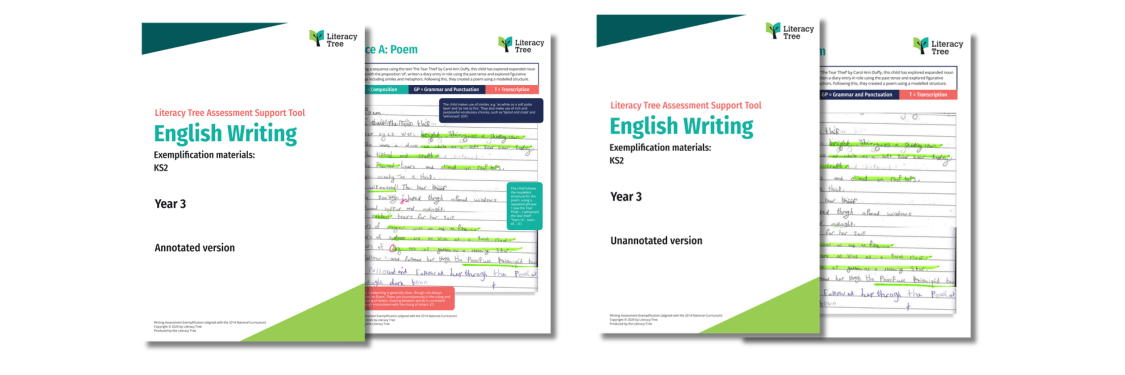
3. There are annotated and unannotated versions
Each year group (Years 1, 3, 4 and 5) is supplied with:
- an unannotated version for internal training, moderation and discussion
- an annotated version to support training and benchmarking
This was an intentional choice in the resource design. Our goal is not to hand teachers answers immediately but to support professional conversations across teams, building teacher confidence and expertise.
How schools can use the exemplification materials
We recommend introducing these materials as part of internal professional dialogue around assessment and writing moderation. Do you have staff who are new to teaching? Perhaps you have staff who are new to a year group? Make use of these materials to support with aligning assessment judgements and an understanding of what writing outcomes can look like. This could be within a staff meeting, a phase meeting or a trust-wide training session.
Begin with the unannotated version, discussing what can already be celebrated with reference to our Steps-in-Progression and RATE assessment tool. These are all aligned with the National Curriculum and the professional dialogue is an important part in developing a team approach to developing literacy. After rich discussion, cross-reference this with the annotated version of the Exemplification Materials alongside examples of writing from you own classes.
In this way, the Exemplification Materials support teachers in standardising assessments ready to inform their own practice. We hope that they will provide support in developing an understanding of children’s literacy, and that they give further confidence to teachers.
These materials work brilliantly in:
- staff meetings
- INSET sessions
- phase moderation
- trust-wide standardisation
Explore the Exemplification Materials