Written by:
Jess White
Resource Developer
In part one of the Story Sapling blog series, we shared how the approach came about and explored the Start With a Story pedagogy that sits behind it. In this follow-up, we’re getting practical. How can you take a Story Sapling and make it work for your children, your routines and your setting?
At its heart, a Story Sapling is flexible, language-rich and immersive. It is not designed to be a script or a “do it all” resource. Instead, practitioners can take what is useful, adapt what fits, and build from there. The format of Story Saplings allows practitioners space for careful annotations, leading to flexibility throughout the sequence.
The Adult Led Learning gives children a strong starting point: a carefully chosen story, rich vocabulary and clear modelling of purposeful writing. After that, you bring in the most important ingredient: your knowledge of your class. You decide which activities will help your children explore the language, ideas and writing opportunities further.
In this post, we’ll walk through the different parts of a Story Sapling and think about how they might support EYFS learners in real classrooms. We’ll use Stage 8 of the Story Sapling for These Are My Rocks by Bethan Woollvin as our example.
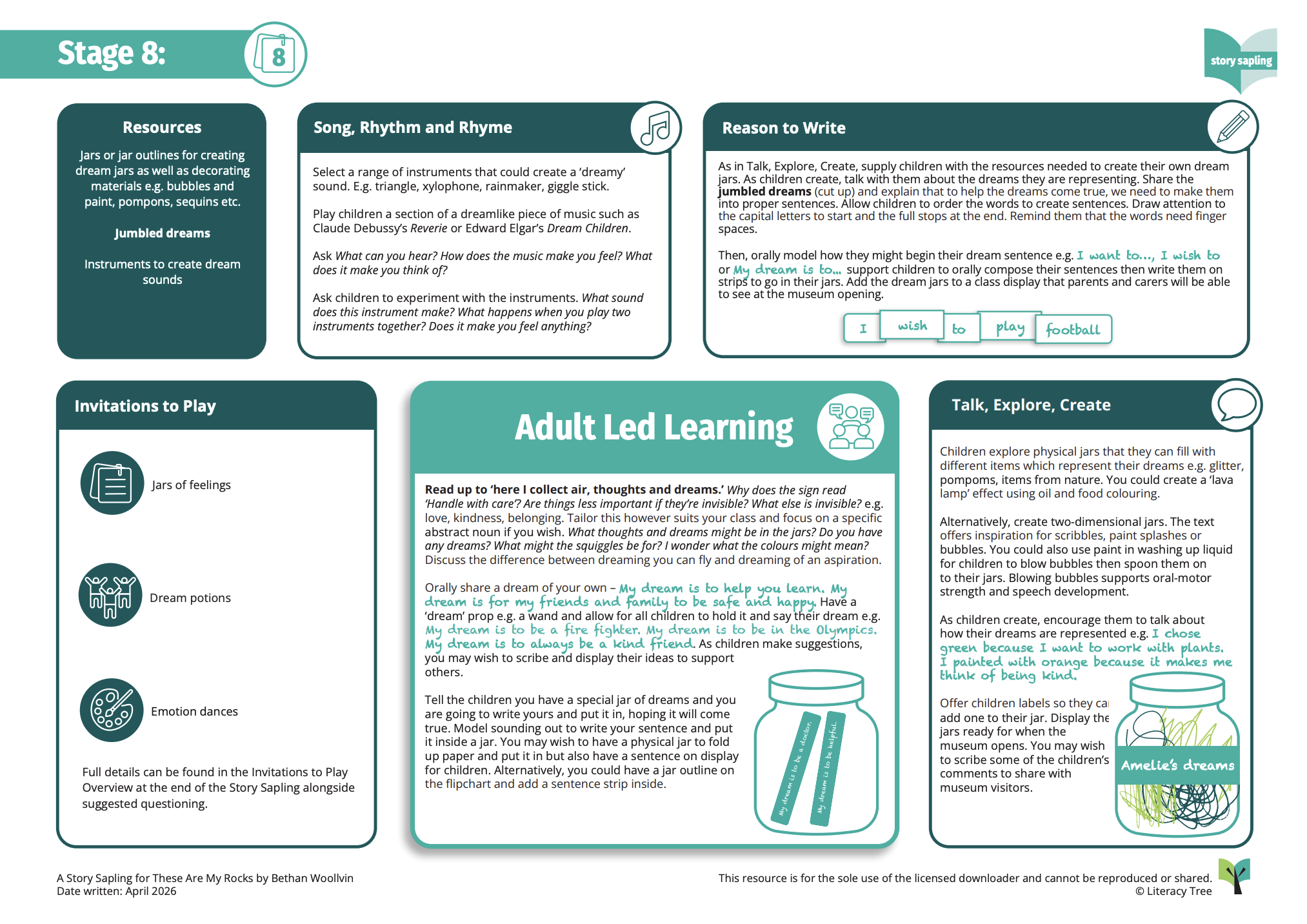
In the Adult Led Learning for this stage, the practitioner models saying a sentence aloud about their dreams or aspirations. They then write down some of these ideas, including suggestions from the children, and add them to a “jar of dreams”. Practitioners then use their professional autonomy to guide their choices.
 |
Talk, Explore, Create
Great for – fine motor skills, oracy, rehearsing new vocabulary, peer-to-peer talk, conversation extended by adults
What?
In this activity, children create their own ‘dream jars’. With peers, they use the first person as well as the sentence structure (orally modelled in the Adult Led Learning) to describe aspirations. They may place items representing dreams into three-dimensional jars or use painting techniques to create paper versions. Some children may feel motivated to label their dream jar with their name.
When?
Practitioners might set this up as a focus activity with an adult to support or for children to access independently during free flow. In mixed age settings, practitioners may choose for younger learners to engage with the Talk, Explore, Create rather than the Reason to Write. It’s a valuable opportunity for EYFS children of all ages to develop fine motor skills and communication and language.
Reason to Write
Great for – fine motor skills, application of phonics, working towards writing ELGs, oracy, rehearsing new vocabulary
What?
In some stages or settings, some children may access the Talk, Explore, Create alone. Sometimes, practitioners may choose to set up the Reason to Write. In the example we are exploring here within Stage 8 of this Story Sapling, children revise the grammatical structure of sentences e.g. including a capital letter and full stop, using the jumbled dreams resource.
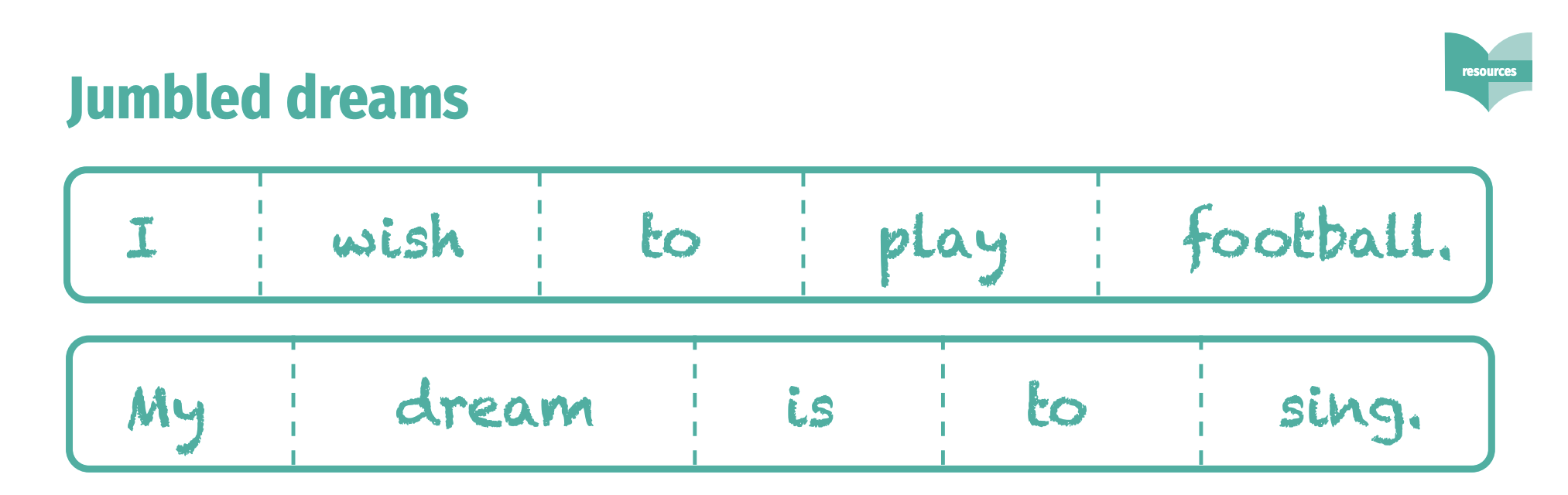 |
Children then write their own dream sentences and add them to a dream jar. Practitioners can tailor this to their phonics approach. Some children may be mark making, in which case practitioners could scribe their dictated ideas to acknowledge the child’s efforts. In other cases, children may be writing single words. The essential component is that all children are valued creators and communicators with a reason to write.
When?
Most Reasons to Write work best when supported by an adult. However, settings may wish to set these up as independent activities, especially when modelled through the Adult Led Learning. It is not necessary for all children to complete all Reasons to Write within a Story Sapling. Practitioners can select the purposes they feel will most appeal to their children and support their level of progression in relation to language, grammar and vocabulary.
Song, Rhythm and Rhyme
Great for – sense of community, oral muscle development, gross motor development, proprioception, language development, phonics progression
What?
In the Song, Rhythm and Rhyme from Stage 8 given as an example here, children listen attentively to and talk about a piece of music, they may be encouraged to discuss the changes and patterns they observe aurally. Children then engage with making their own ‘dream music’ using a range of instruments.
When?
This Song, Rhythm and Rhyme opportunity could be explored in a carpet session or spread over the day; first listening to the music then having the instruments set up in free flow. Many of the Song, Rhythm and Rhyme opportunities involve well known nursery rhymes. These may be used at any point in the day with gross motor actions included. While there are Song, Rhythm and Rhyme opportunities at every stage of the Story Sapling, most practitioners will select a few favourites to learn and rehearse.
Invitations to Play
Great for – oracy, language acquisition, communication and language, fine motor skills, gross motor skills, collaboration, creativity, independence, play!
What?
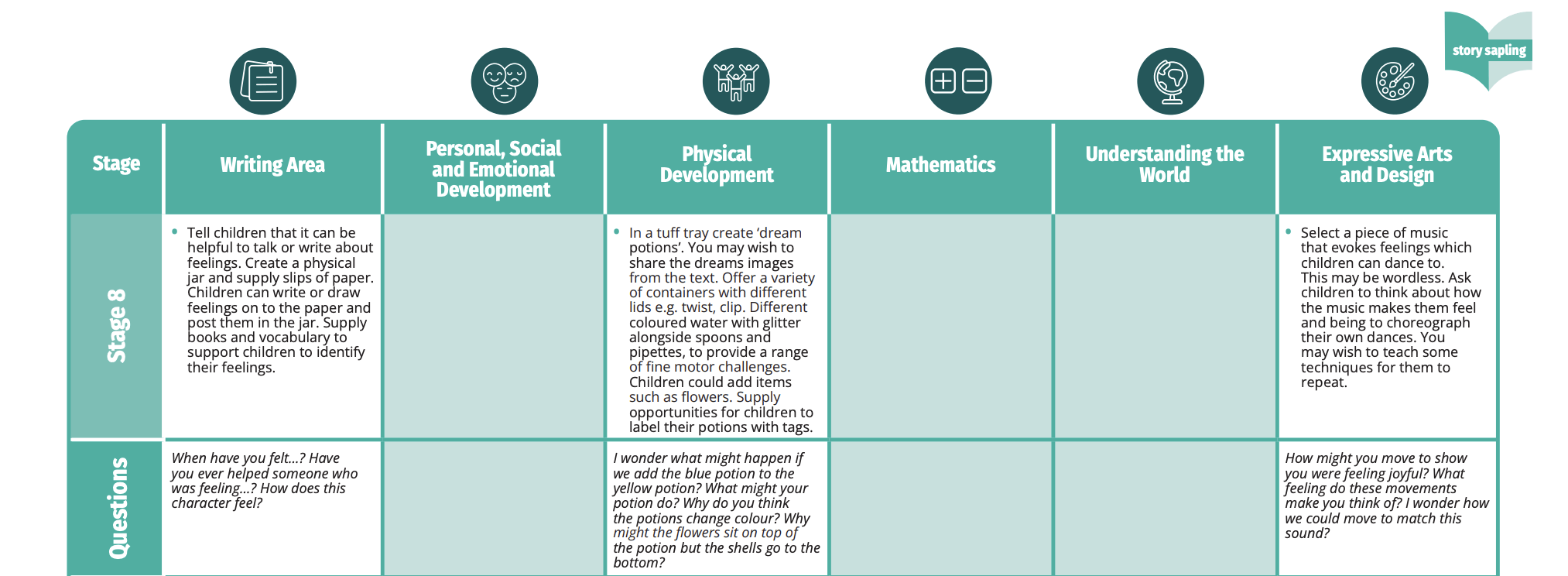
Each stage of a Story Sapling has at least three Invitations to Play. One of which is designed to inspire writing and may be set up in a writing area or anywhere with tools and mediums for writing. Another is a physical development opportunity for targetting either fine or gross motor skills. The last Invitation to Play relates to another prime or specific area. Invitations to Play may be challenges or provocations for children but practitioners may also choose to leave such opportunities open ended with no pre-designated purpose.
 |
When?
Practitioners may select a few Invitations to Play over the course of the Story Sapling or set up a novel one for each stage. The suggested questioning is provided as a starting point for adults looking to extend child talk. Best practice suggests that talk should follow the interests of children rather than scripted questioning from adults, so questions are designed to suggest, prompt and extend.
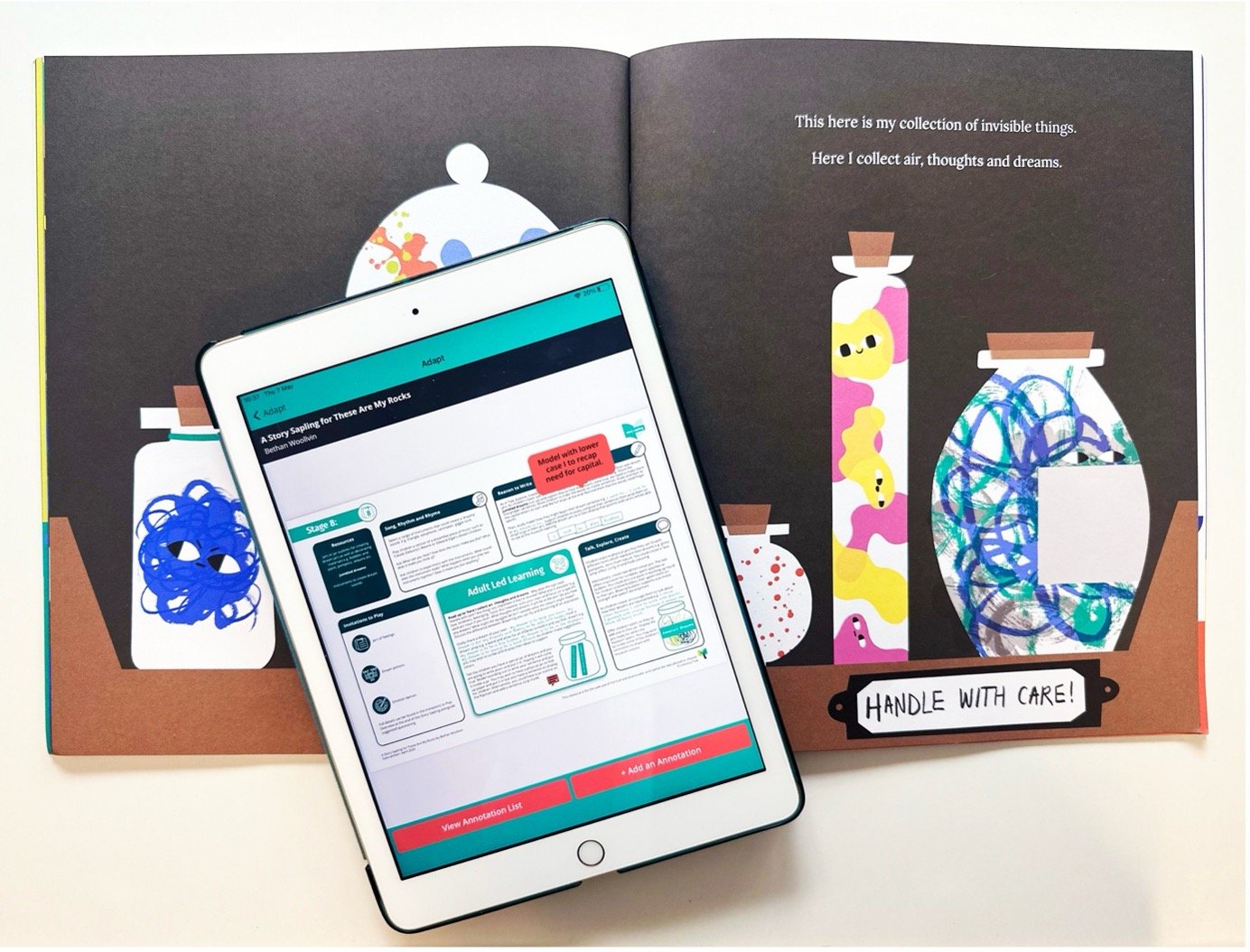
Annotating using the App
Story Saplings are designed to be adapted, to work harmoniously with children’s individual learning and interests. Our app is a great tool for practitioners to annotate and adapt the sequence before printing and facilitating.
 |
We can’t wait to see our Story Saplings in the wild. Please send any work samples to worksamples@literacy.com or upload them via the Literacy Tree App.